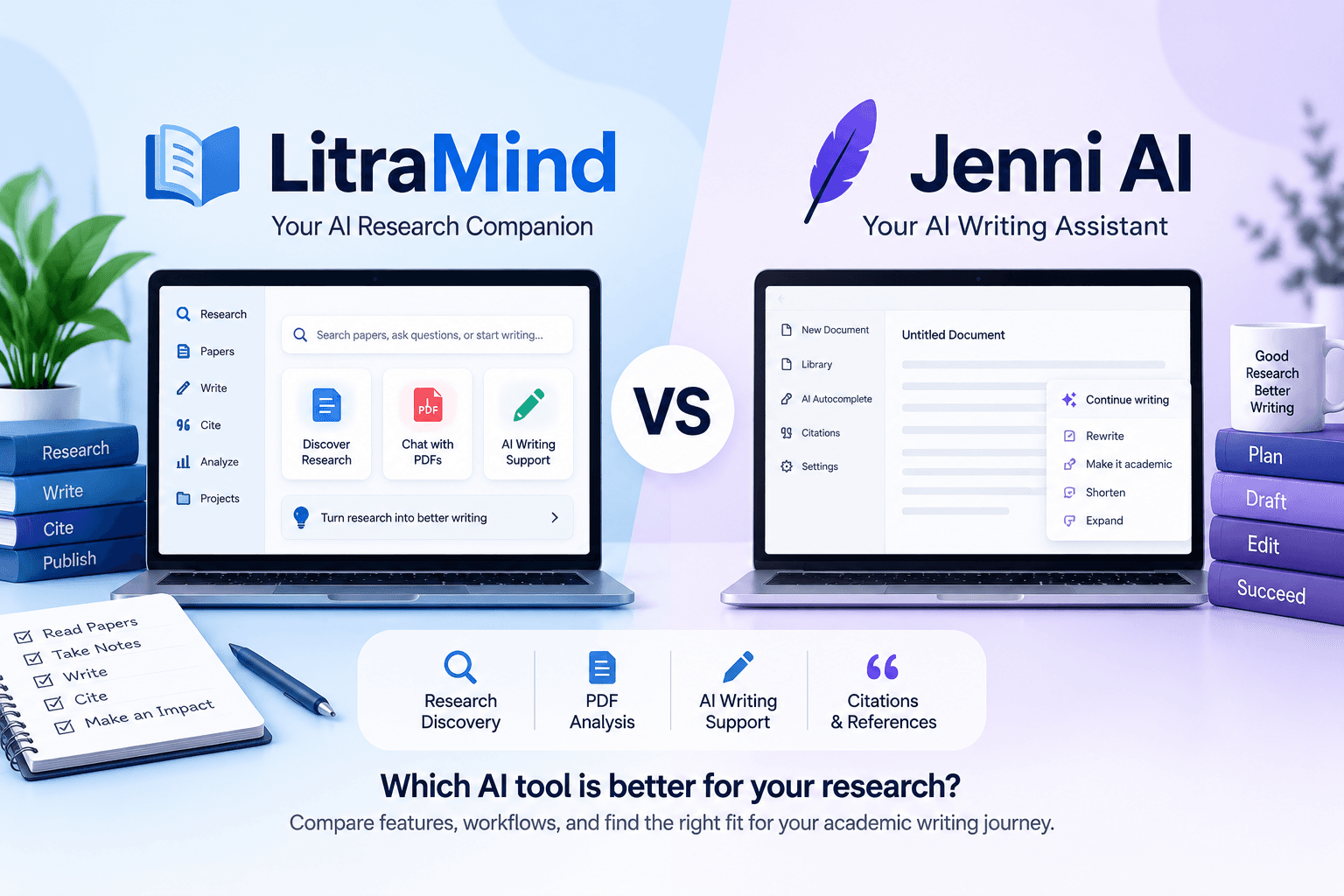
Academic writing is no longer limited to a blank document and a reference manager. Researchers now have access to AI workspaces that can help discover literature, analyze papers, draft sections, insert citations, and refine manuscripts.
But having more AI tools does not necessarily make research easier. The real question is how well a platform connects the different stages of academic work. Research discovery, reading, writing, citation management, revision, and manuscript preparation are closely connected activities. When those activities are scattered across multiple applications, researchers can spend almost as much time managing the workflow as doing the research itself.
This is where the comparison between LitraMind and Jenni AI becomes useful. Both are built to support academic writing and research, but they approach the experience from somewhat different workflow perspectives.
In this guide, we compare the two platforms across the areas that matter most to researchers: AI writing, research discovery, PDF workflows, citation management, literature research, and manuscript refinement.
Table of Contents
LitraMind vs Jenni AI at a Glance
At a high level, both platforms aim to help researchers work more efficiently with AI. The difference becomes clearer when you look at the complete workflow each platform is designed to support.
| Capability | LitraMind | Jenni AI |
|---|---|---|
| Academic writing | AI-assisted drafting, rewriting, and manuscript refinement | AI-assisted writing, autocomplete, editing, and document tools |
| Research discovery | Research and citation discovery integrated into the writing workflow | Literature discovery, citation search, and research library |
| PDF workflows | Upload and work with research documents | PDF library, reader, search, and AI-assisted research workflows |
| Citations | Citation discovery, insertion, and bibliography workflows | Citation search, automatic bibliography, and extensive style support |
| Manuscript workflow | Research → Write → Cite → Rewrite → Refine | Research Library → Write → Cite → Review → Export |
The important point is that these capabilities overlap significantly. This is not a comparison between an academic writing platform and a completely unrelated tool. Both are designed around research-oriented writing.
What Is LitraMind?
LitraMind is an AI-powered academic writing workspace designed around the broader research-paper workflow. Instead of treating writing as an isolated activity, the platform connects research discovery, source analysis, drafting, citations, rewriting, and manuscript refinement.
That distinction matters because a research paper rarely moves in a straight line. A researcher may begin by searching for literature, open several papers, return to an earlier section, discover a supporting source, rewrite a paragraph, add a citation, and then revise the argument again.
A research workspace is most useful when it supports those transitions without forcing the researcher to repeatedly change tools or lose context.
The LitraMind workflow
Research → Understand → Write → Cite → Rewrite → Refine
What Is Jenni AI?
Jenni AI is an AI workspace built for researchers to read, write, and cite. Its current research workflow includes a research library, PDF reader, citation management, literature discovery, and AI-assisted writing.
Its writing environment includes a document editor, AI autocomplete, editing tools, AI chat, reviews, and other academic writing features.
Citation management is also a major part of the platform. Jenni supports citation search and insertion, automatic bibliography generation, DOI-based citation workflows, PDF metadata extraction, BibTeX import and export, and integrations with reference managers such as Zotero and Mendeley.
In other words, Jenni is not simply an AI text generator. It is designed to combine research sources with an academic writing environment.
AI Writing and Drafting
AI writing is one of the first areas researchers usually consider when comparing academic writing platforms. But the important question is not just whether a tool can generate text. It is how that generated text fits into the researcher's existing argument and sources.
LitraMind: writing with research context
LitraMind focuses on helping researchers move from research material to usable manuscript content. AI assistance can be used for brainstorming, drafting sections, summarizing literature, rewriting passages, and developing parts of a research paper.
The advantage of this approach is that AI writing becomes one stage inside a larger research workflow rather than the entire workflow itself.
Jenni AI: AI-assisted writing and autocomplete
Jenni AI places significant emphasis on AI-assisted writing, including AI autocomplete and source-grounded suggestions. Its documentation describes a writing environment where researchers can work alongside AI while using their research sources as context.
For researchers who enjoy writing interactively with AI suggestions, autocomplete can make the drafting process feel fast and continuous.
The key difference
The question is not simply "Which tool writes better?"It is "Which writing workflow fits the way you actually research?"
Research Discovery and PDF Workflows
Research rarely begins with writing. It usually begins with questions: What has already been studied? Which papers are relevant? What methods have other researchers used? Where does the existing literature disagree?
This makes research discovery and PDF analysis critical parts of any academic AI workflow.
LitraMind for research
LitraMind connects research discovery with academic writing so that researchers can move from finding relevant sources to understanding and using them in a manuscript.
This is particularly useful when the same source needs to influence multiple parts of a paper. Instead of treating a paper as something you cite once, the research workflow can return to the source while drafting, rewriting, or refining an argument.
Jenni AI for research
Jenni AI provides a centralized research library where users can organize sources, upload PDFs, import references, and work with papers while writing. Its current documentation also describes a built-in PDF reader and workflows for discovering open-access papers.
This source-centered approach can be particularly helpful for researchers who already have a substantial collection of papers and want to bring those sources into their writing environment.
Citation Management
Citations are one of the most time-consuming parts of academic writing when they are handled manually. Researchers need to find the right source, insert the citation, maintain the reference list, and make sure the formatting matches the journal's requirements.
LitraMind
LitraMind integrates citation discovery and bibliography workflows into the research-writing process. Researchers can discover relevant papers, insert citations, and maintain references while developing the manuscript.
Jenni AI
Citation management is one of Jenni AI's more developed research features. Its current documentation describes citation search, inline insertion, library citations, automatic bibliography generation, DOI resolution, BibTeX import/export, and reference-manager integrations.
Jenni also supports a large collection of citation styles, including common styles such as APA, Chicago, Harvard, IEEE, and Vancouver.
For researchers who spend significant time managing references, citation depth should therefore be an important part of the decision rather than an afterthought.
Comparing the Complete Research Workflow
The biggest difference between academic AI platforms often appears when you stop looking at individual features and look at the complete workflow.
Discover
Find relevant research and identify sources that can support your argument.
Understand
Read, analyze, and extract useful information from papers and research documents.
Write
Turn research findings and ideas into coherent academic sections.
Cite
Connect claims with appropriate sources and maintain the reference list.
Refine
Rewrite, strengthen arguments, improve clarity, and prepare the manuscript for submission.
Verify
Check citations, references, originality, and manuscript quality before submission.
LitraMind approaches this as a connected academic workflow, while Jenni AI also brings research, writing, citation, and review features into a single workspace. Jenni's documentation explicitly describes its workflow around importing sources, asking questions across a library, drafting from evidence, tracing claims, and reviewing before submission.
That means the decision should not be based on a single feature. A researcher should consider how the platform fits into the entire process from the first paper discovered to the final manuscript revision.
Which Tool Is Right for You?
There is no universal answer to which academic AI platform is best. Different researchers have different workflows, writing habits, source collections, and requirements.
Choose LitraMind if you want:
- A broader research-to-manuscript workflow
- Research discovery connected to academic writing
- AI-assisted drafting and rewriting
- A workflow that brings research, writing, citations, and refinement together
- A workspace designed specifically around research-paper creation
Consider Jenni AI if you want:
- AI autocomplete integrated directly into academic writing
- A centralized research library
- PDF reading and source management
- Extensive citation search and formatting capabilities
- A source-oriented academic writing environment
The strongest choice is therefore the platform that matches your actual working style. If you already have a highly structured reference-management workflow, your priorities may differ from those of a researcher who wants research, writing, and revision to happen in one continuous environment.
Final Verdict: LitraMind vs Jenni AI
LitraMind and Jenni AI are both designed to address a problem that traditional writing tools do not solve particularly well: academic research involves much more than typing words into a document.
Jenni AI offers a strong combination of AI-assisted writing, research-library management, PDF workflows, and citation tools. Its current platform emphasizes source-grounded writing and traceable research workflows.
LitraMind, meanwhile, is designed around connecting more of the research-paper journey: discovering research, understanding sources, drafting, citing, rewriting, and refining the manuscript.
The bottom line
If your priority is AI-assisted academic drafting and autocomplete, Jenni AI is a capable option. If your priority is connecting literature discovery, source analysis, writing, citations, rewriting, and manuscript refinement into one research workflow, LitraMind is designed for that broader experience.
Frequently Asked Questions
LitraMind is designed to bring research discovery, source analysis, AI writing, citations, rewriting, and manuscript refinement together in one academic workflow. Jenni AI is focused on AI-assisted academic writing, research libraries, citations, and document workflows. The better choice depends on which parts of the research process matter most to you.
Yes. LitraMind can be considered an alternative to Jenni AI for researchers looking for an AI-assisted academic writing and research workspace. Both tools support research-oriented writing and citation workflows, but their interfaces and workflow approaches differ.
LitraMind is designed to support research-paper workflows including research discovery, source analysis, drafting, rewriting, citation management, and manuscript refinement. The goal is to reduce the need to move between separate tools while developing an academic manuscript.
Both can support academic writing, but researchers may prefer one depending on their workflow. If your priority is AI-assisted drafting and autocomplete within a research environment, Jenni AI is worth considering. If you want a broader workflow connecting research, source analysis, writing, citations, rewriting, and manuscript refinement, LitraMind may be a better fit.
Build a Better Research Writing Workflow
Research, write, cite, rewrite, and refine your academic work in one connected workspace with LitraMind.
The best academic AI tool is not necessarily the one with the longest feature list. It is the one that removes the most friction from the way you actually research and write.
Whether you are writing a journal article, thesis, dissertation, literature review, or research manuscript, the goal should remain the same: use AI to accelerate the work without losing control of the research, evidence, reasoning, and final argument.