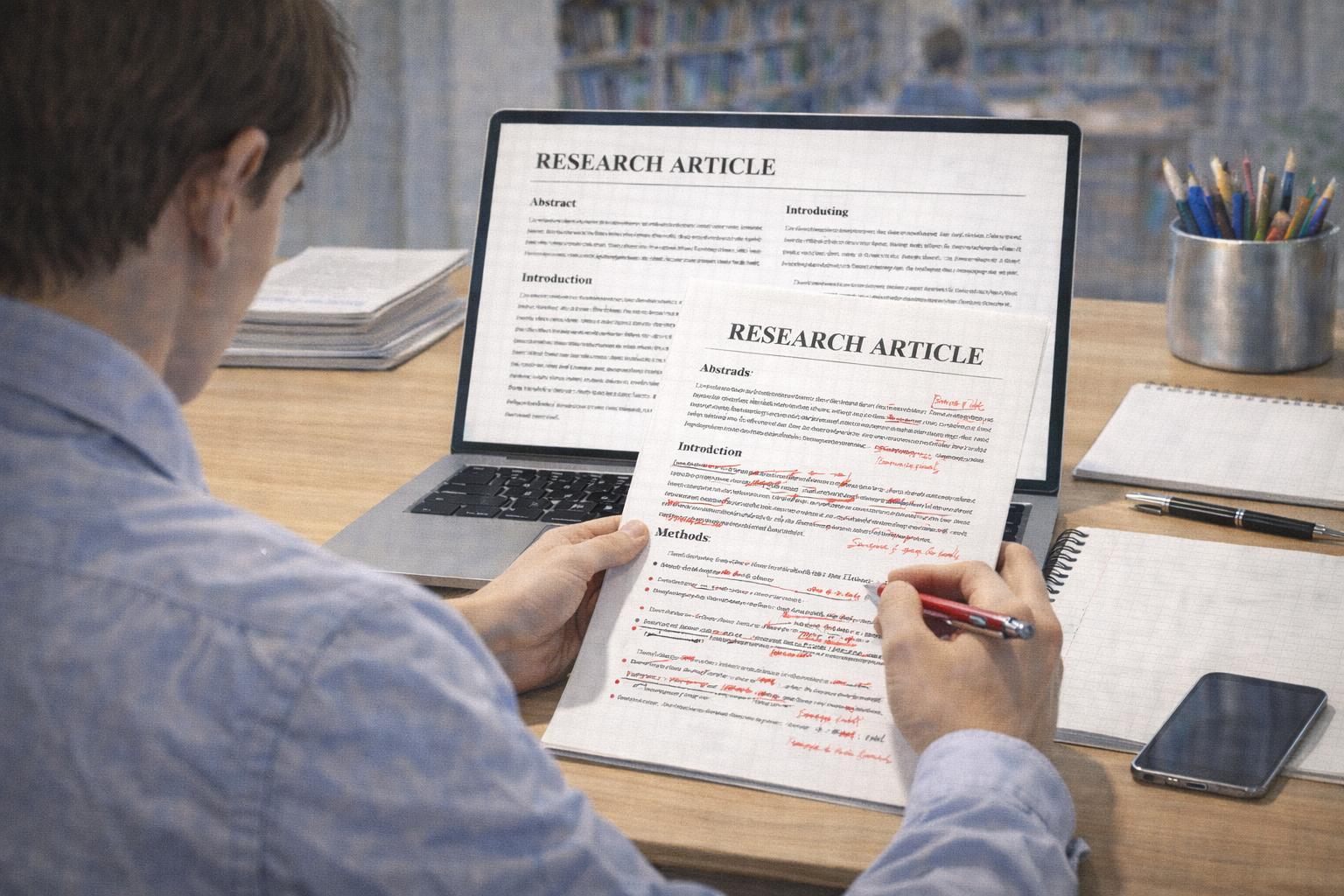
Reading papers is most of the job, and almost nobody is taught to do it. The default is to treat a paper like a book: open it at the start and keep going until the end. That's slow, and it gives the same attention to a paper you'll cite once as to the paper your whole thesis rests on.
In 2007, S. Keshav, a computer scientist at the University of Waterloo, published a two-page note called How to Read a Paper in ACM SIGCOMM Computer Communication Review. It has been assigned in graduate courses across most disciplines since, because it fixes the default. Read in passes, each with a different goal, and stop as soon as you know enough.
This guide explains the method, then works through what it means in hours for a literature review of 40 papers. It closes with a note template and a section-by-section list of what to check.
Why front-to-back reading wastes time
Research papers aren't written to be read in order. The abstract and introduction say what the paper claims. The conclusion says what the authors want you to remember. The methods and results are there so that a reader who cares can check the claim. If you start with the methods, you're checking details before you know what they're meant to support.
Reading linearly causes three problems:
- Everything gets the same depth. A paper you'll mention in one sentence costs you as much as a paper you need to understand completely.
- You can't decide early. You find out on page 12 that the paper studied a different population from yours.
- Nothing sticks. Without a question in mind, details pass by without anywhere to attach.
The three-pass method
Keshav's idea is to read a paper in up to three passes. Each one builds on the last, and after each one you decide whether to continue.
- 5–10 minFirst pass: what the paper is and whether it matters to you
- Up to 1 hrSecond pass: the content and evidence, without the fine detail
- 1–5 hrsThird pass: full understanding. About an hour once you're experienced
Pass 1: the bird's-eye view
Five to ten minutes. In this order:
- Read the title, abstract and introduction carefully.
- Read the section and subsection headings, and nothing else in the body.
- Read the conclusion.
- Glance over the references and note the ones you already know.
At the end you should be able to answer what Keshav calls the five Cs:
| C | The question | Why it matters for your review |
|---|---|---|
| Category | What type of paper is it? Trial, survey, case study, review, theory, methods? | Decides how much weight it can carry in your argument |
| Context | Which papers and theories does it build on? | Places it in the conversation you're writing about |
| Correctness | Do the assumptions look valid? | An early warning before you build on it |
| Contributions | What does it add that wasn't known? | The sentence you'll eventually write about it |
| Clarity | Is it well written? | Tells you how much effort the next pass will take |
Many papers stop here, and that is the point. If a paper is off-topic, outside what you can currently follow, or rests on assumptions you don't accept, you've spent ten minutes rather than an afternoon.
Pass 2: the content, not the details
Up to an hour. Read the whole paper with more care, but skip proofs and derivations. Make notes in the margin as you go. Two things deserve particular attention:
- Figures and tables. Are the axes labelled? Are there error bars or confidence intervals? Does the figure show what the text says it shows? Keshav notes that mistakes here are what separate rushed work from excellent work.
- Unread references. Mark the ones that look important. This is how you find the key papers in a field you're new to.
After the second pass you should be able to summarize the paper's argument, with its evidence, to someone else. For most papers in a literature review, that's enough.
Pass 3: rebuild it yourself
The third pass is for the few papers your work depends on, or a paper you're reviewing. The aim is to virtually re-implement it: start from the same assumptions and work out how you would have done the study. Comparing your version with theirs shows you both what is new and what's been assumed without saying so.
Question every assumption. Note missing citations, weaknesses in the method and ideas for future work, because this is where research gaps come from. Keshav estimates four or five hours for a beginner and about an hour for an experienced reader. At the end you should be able to rebuild the structure of the paper from memory.
What this means for a 40-paper literature review
The method makes the most difference when you're reading a lot. Suppose your search has turned up 40 relevant papers. Using Keshav's time estimates, here are two ways to read them.
| Approach | What you do | Time |
|---|---|---|
| Read everything properly | A careful, second-pass read of all 40 papers at about an hour each | about 40 hours, and still no deep understanding of the papers you depend on |
| Three-pass triage | First pass on all 40 (10 min each, about 7 hours). Second pass on the 15 that matter (15 hours). Third pass on the 3 central papers (3 to 15 hours, depending on experience). | 25 to 37 hours, with full understanding of the three papers that matter most |
The 15 and the 3 are illustrative; your numbers will differ. The pattern doesn't. Triage saves somewhere between a few hours and two working days, and it puts deep reading where your argument needs it instead of spreading it thinly across everything. A beginner gets the smallest saving, and needs the triage most: the hours a new researcher spends on a third pass are the hours they'd otherwise lose on 40 shallow reads.
Keshav also describes a search routine. Find three to five recent papers and give each a first pass. Read their related-work sections, looking for a recent survey; if there is one, start there. If not, look for citations and author names that recur across the bibliographies. Those are the key papers and people. Then check where those people have published recently to find the main venues, and scan their recent issues.
Section by section: what to check
The second pass goes faster if you know what each section is supposed to give you and where papers tend to be weak.
| Section | What to take from it | Warning signs |
|---|---|---|
| Abstract | The claim, the method and the headline result | A result more confident than anything in the results section |
| Introduction | The gap the authors say they fill, usually in the last paragraph or two | A gap described as "few studies have examined" with no citations |
| Methods | Who or what was studied, how many, and how it was measured | Small or convenience samples treated as general; outcomes that change from the protocol |
| Results | Effect sizes and uncertainty, not just p-values | Many outcomes tested, only the significant ones discussed |
| Discussion | How the authors interpret the results and what limits they admit | Causal language for a correlational design; limitations that are only generic |
| References | The papers this one is in conversation with | Mostly self-citations, or missing work you know is central |
Adjust the order to the type of paper
- Empirical studies: after the first pass, go to the main results table or figure before the methods. You'll know what the methods need to justify.
- Systematic reviews and meta-analyses: read the search strategy and inclusion criteria early. A review is only as good as what it let in. The forest plot or summary table is the heart of it.
- Theory and methods papers: look for one worked example and read it closely. It's usually clearer than the general argument.
- Qualitative studies: look at how participants were chosen and how themes were derived, then read the quotations against the themes they're meant to support.
Take notes you can write from
Reading pays off only if you can find what you read when you write. Highlighting doesn't do that. A short structured note does. Keep one per paper, written in your own words:
- Reference: full citation, so you never have to look it up twice
- Pass reached: 1, 2 or 3
- Question: what the authors set out to answer
- Method and sample: design, who or what, how many
- Main finding: one or two sentences, with the page number
- Limitations: the authors' and yours
- For my work: supports, contradicts, extends, or provides a method
The last line is the one people skip and the one that matters most. When you come to write, you don't need 40 summaries. You need to know which papers agree, which disagree and why. If you're working through a large set, our guide to organizing 50+ papers for a literature review shows how to turn these notes into a matrix.
Where AI tools help, and where they don't
AI tools are useful for navigation. In LitraMind, you can open a PDF with Chat with Files and ask where the sample size is reported, which limitations the authors list, or how a term is defined. Answers come with page references, so you can go straight to the passage and read it yourself. That makes the second pass quicker, particularly on long papers with unfamiliar structure.
There are things a tool can't do for you:
- Decide what matters. Whether a paper is central to your argument depends on your argument.
- Do the third pass. Rebuilding a study in your head is how you find its weaknesses, and it only works if you do it.
- Be trusted without checking. Summaries can miss a qualification or misstate a number. Check anything you'll cite against the page.
A side effect: you'll write better papers
Keshav points out that most reviewers and readers will give your paper one pass. If they can't get the gist from your title, abstract, headings and conclusion in about five minutes, it may never be read further. Once you read this way, you start writing for it: informative headings, an abstract that states the result, and a conclusion that answers the question in the introduction. For more on that last part, see how to write a strong discussion section.
Checklist
- Do a first pass on every paper before reading any of them in depth
- Answer the five Cs and decide: stop, second pass or third pass
- On the second pass, check figures and tables against the text
- Mark unread references that keep coming up
- Reserve the third pass for the papers your argument depends on
- Write one structured note per paper, ending with how it relates to your work
- Check any AI-generated answer against the page before you cite it


